
What Is a Design Engineer in Software? I Became One at ViewStats
What is a design engineer in software? A designer who ships the code. How the role works, tools, real examples, and how to become one, from someone doing it.
What is a design engineer? In software, a design engineer is a designer who builds what they design. They work across the gap between a Figma file and production code: they design the interface, prototype it with real interactions, write front-end code such as React or SwiftUI components, and review the implementation until it feels right. It is not the mechanical or civil engineering job with the same name, which is about physical products and CAD. I have worked as a product designer for more than 12 years, and at ViewStats, the creator platform built by the team behind MrBeast, my role grew from Lead Product Designer into design engineer. I worked in the codebase with Cursor, Claude Code, React, TypeScript and GitHub, built components and opened pull requests. This guide explains the role from the inside: what it is, what it is not, the tools, real examples and how to become one.
What is a design engineer in software? A plain definition
The shortest definition I can give: a design engineer owns the last mile of the interface. A product designer decides what the product should do and how it should feel. A front-end developer makes it work reliably at scale. A design engineer sits in the overlap and makes sure that what ships is the thing that was designed, including the parts a static mockup cannot show.
Those parts are bigger than people think. Timing of an animation. How a list behaves with 3 items and with 3,000. What happens when the network is slow. How a gesture feels under your thumb. The spring on a sheet as it settles. Empty states, loading states, error states. In a classic handoff, these get described in a spec, interpreted by a developer, reviewed by a designer, fixed, reviewed again. A design engineer collapses that loop by doing the work directly in code.
So the role is less a new job title and more a change in where the designer stops. Most designers stop at the file. A design engineer stops at the shipped product.
If you want the broader picture of the design role first, I wrote a long guide on what a product designer does. This page is the next step: what happens when that designer also ships.
Design engineer vs mechanical design engineer: the naming problem
Search "design engineer" and half the results are about mechanical, electrical or civil engineering. That is a different profession. A mechanical design engineer designs physical parts and products with CAD software, works with tolerances, materials and manufacturing, and usually has an engineering degree and sometimes a professional license.
The software design engineer I am describing comes from the design side of tech companies. You will also see it called UX engineer, design technologist, creative developer or prototyper. The labels overlap, and companies use them inconsistently. When you read a job post, ignore the title and look at the verbs: if it asks you to design interfaces and ship front-end code, it is this role.
One more naming trap: "software design engineer" sometimes means a software engineer who designs systems architecture, like databases and services. That is backend engineering, not interface design. The autocomplete for "software design engineer vs software engineer" shows how often people mix these up.
What a design engineer does day to day
I will use ViewStats as the example, because it is where the role became real for me. You can read the full ViewStats creator platform case study, but here is the part that matters for this question.
I led design across the web app, mobile app, Chrome extension, website, growth work, AI experiences and the design system. The platform grew to more than 500,000 users, the extension to more than 200,000 users, and the mobile app to more than 100,000 downloads. Over time, my role expanded beyond design into engineering. I designed, prototyped, built React components, opened pull requests and reviewed the implementation of the screens I had designed.
In practice, a week looked like a mix of these:
- Designing a feature in Figma, close enough to make decisions, not pixel-perfect for its own sake.
- Building the interactive version directly in the codebase, using AI coding tools to move faster.
- Turning repeated patterns into design system components: tables, forms, dashboard pieces, empty states.
- Opening a pull request, getting it reviewed by engineers, fixing what they caught.
- Reviewing other people's implementation of designed screens, in code rather than in screenshots.
The effect was dramatically shorter iteration cycles. When the person who made the design decision can also adjust the code, a small fix that used to take a ticket, a sprint and a review round can happen the same afternoon.
The case study also covers the AI tools we shipped, including thumbnail generation, text to thumbnail, face swap, variations and AI titles, which went from concept to launch in roughly two weeks. That speed only works when design and implementation are not separated by a wall.
Design engineer vs front-end developer vs product designer
These three roles share a lot, so the differences are about emphasis and ownership. Here is how I would explain it to a founder deciding who to hire.
| Product designer | Design engineer | Front-end developer | |
|---|---|---|---|
| Core question | What should we build and why? | Does what we ship feel like what we designed? | Does it work reliably, fast and at scale? |
| Main output | Research, flows, designs, decisions | Designs plus production UI code and prototypes | Production code, architecture, tests |
| Typical tools | Figma, research tools, analytics | Figma, Cursor, Claude Code, React, SwiftUI | React, TypeScript, build tools, testing |
| Strongest at | Problem framing, user insight, flows | Interaction, motion, polish, design systems in code | Performance, data, state, reliability |
| Weak spot if alone | Details lost in handoff | Deep backend and infrastructure | Product judgment and visual detail |
| Hire first when | You do not know what to build yet | You know what to build and the UI must feel great | You need scale and stability |
My honest view: a design engineer is not a replacement for either of the others. A good design engineer still needs product judgment, and a real product still needs engineers who care about architecture and tests. The role works best as a bridge, which is exactly why it grows in small, fast teams. If you are comparing other design titles, I covered the product designer vs UX designer difference separately.
Design engineer skills and tools
People expect a list of frameworks here. The frameworks matter less than three underlying skills.
Taste with a deadline. Knowing when something feels wrong, and being able to fix it before the release, not after. This is the design half and it does not go away because you write code.
Reading and shaping code. You do not have to be a senior engineer. You do have to read a component, understand props and state, change layout and animation, and know when you are out of your depth and should ask.
Systems thinking. The best design engineering work is often invisible: tokens, variables and components that make every future screen better. At ViewStats the design system covered typography, color, navigation, data visualization, dashboard components, tables, forms, empty states, variables and tokens across web, mobile, marketing and the extension.
The tools I actually use, all listed on my case study and experiment pages:
- Design: Figma, plus Figma motion for entrance animations.
- Design to code: Claude with the Figma MCP, which lets the AI read design context from Figma files.
- Coding: Cursor and Claude Code, React with TypeScript, GitHub for pull requests.
- Native iOS: SwiftUI, Metal shaders, SpriteKit physics, Liquid Glass.
- Web interaction: WebGL shaders, three.js, Rapier and Matter.js physics, Lenis scroll.
- Motion and sound: Rive (including the Rive CLI), Kling and Higgsfield for AI video, ElevenLabs and Web Audio for sound.
You do not need all of these. Pick one platform (web or iOS), one framework and one design tool, and go deep before going wide.
Real examples: what design engineering looks like in practice
Definitions only go so far. The clearest way I know to explain design engineering is to show work that could not exist as a static mockup. I keep a set of playable builds on my AI design experiments page, and each one is a working build, not a picture of one. A few examples:
Payno is a bank card app where freezing your card actually freezes it, and you tap the ice three times to shatter it. It was built with Figma, Claude, the Figma MCP, SwiftUI, alpha video and physics. I broke down how it works in a post on a bank card you shatter to unfreeze. A mockup can show a frozen card. Only code can let you break the ice.
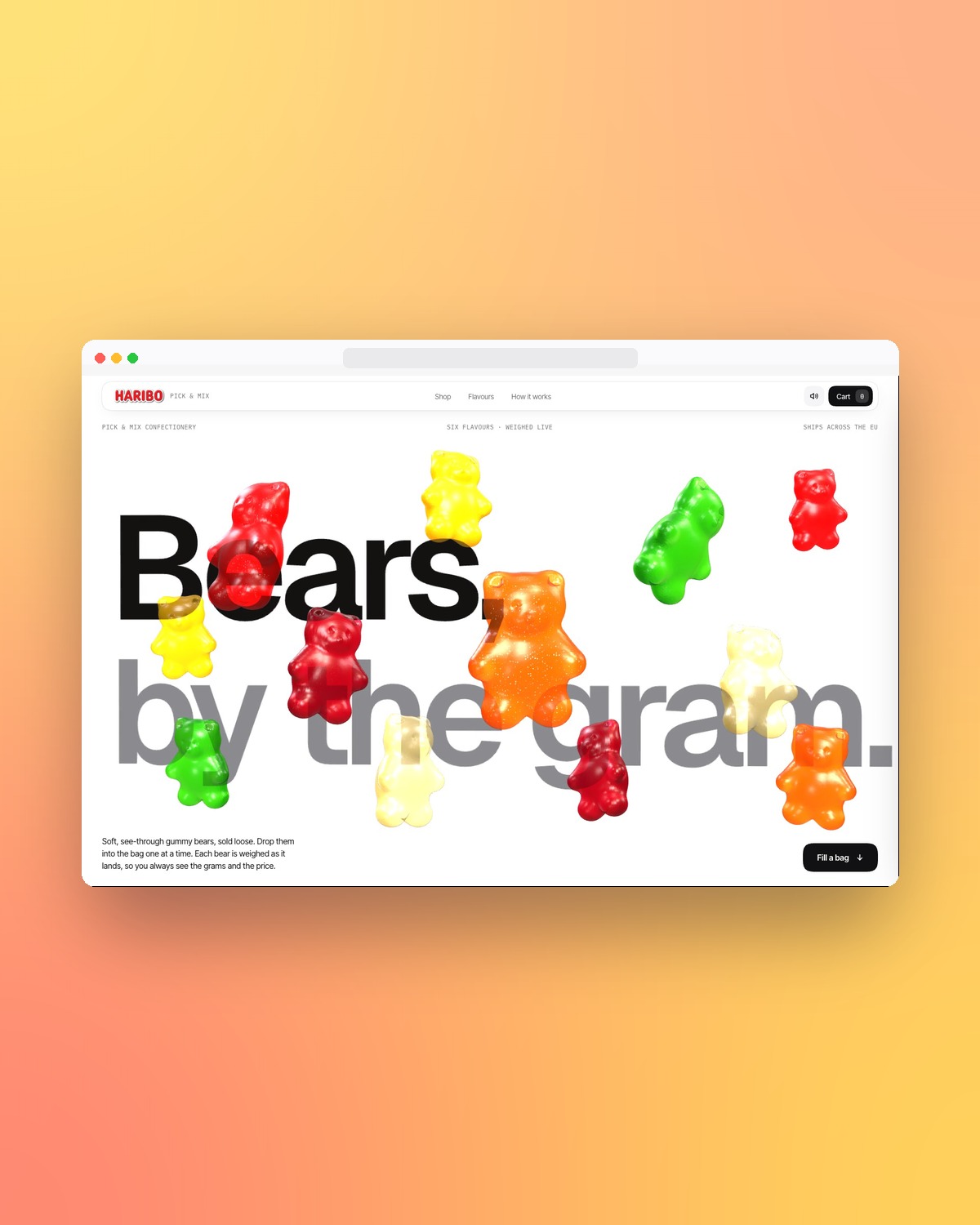
Haribo Pick & Mix is a candy store where real 3D gummy bears pour into the bag and a live scale weighs every bear and updates the price. Built with three.js, Rapier physics and ElevenLabs sound. The design decision, a price that reacts to physics, is inseparable from the engineering.
Traveme is a travel app onboarding that plays like one continuous film. Swipe and the scene moves forward, swipe back and it plays in reverse. That uses SwiftUI and a scrubbable AI-generated film from Kling video.
Pulse Health is a native iOS health app with Liquid Glass and a real water simulation: tap a card, drag the heart chart, pour a glass. Metal shaders and a particle simulation do the work.
NEB X is a landing page with x-ray vision: move your cursor to paint a reveal across the page, then scroll sideways through real 3D products. WebGL shaders, 3D models and Lenis scroll.
Every one of these started as a design idea that a handoff would have flattened. That is the job in one sentence: protect the idea all the way to the running product.
Why AI made the design engineer role grow
Design engineers existed before AI coding tools. What changed is the cost of crossing from design into code. With Cursor, Claude Code and the Figma MCP, a designer who understands code can produce working components far faster than before, and a developer with taste can explore visual options without waiting for a file.
I think about it this way: AI replaces a lot of production work, not judgment. It can write the boilerplate for a component. It cannot decide that the sheet should settle with a softer spring because the content is emotional, or that an empty state should show value before asking for permission. I wrote more about that line in what AI replaced in my product design work.
There is a trust side too. When we shipped AI thumbnail tools at ViewStats, the hardest part was not the interface. It was designing trust. After launch the tools drew public criticism about their impact on artists and thumbnail designers, covered as far as the BBC report on the ViewStats AI tool. The lesson I took: product decisions do not exist in isolation. A design engineer who ships fast also has to think hard about what they are shipping. Speed raises the stakes of judgment, it does not remove them.
The practical result is that more teams now ask for one person who can go from idea to working interface. That is good news for designers willing to learn code, and for developers willing to learn design.
How to become a design engineer
There are two doors into the role, and the path depends on which side you start from.
From the design side
- Pick one platform. Web with React, or iOS with SwiftUI. Do not try both at first.
- Rebuild one of your own designs in code, end to end, including hover, loading and empty states.
- Use AI coding tools as a tutor, not a vending machine. Ask why the code works, then change it yourself.
- Learn the boring parts: Git, pull requests, reading a codebase you did not write.
- Ship something real, even small. A live link beats a polished mockup in any portfolio.
From the engineering side
- Study interaction and motion, not only layout. Copy interfaces you admire, then explain why they feel good.
- Learn Figma well enough to explore ideas there before you code.
- Own a design system component from design to code, including documentation.
- Get feedback from designers on feel, not just correctness.
In both cases, your portfolio should show working things. A design engineer portfolio full of static shots is a contradiction. Link live builds, show before and after, and explain the decision behind each interaction.
When a team needs a design engineer, and when it does not
You probably need one if your product's quality depends on feel: consumer apps, creator tools, onboarding-heavy products, anything with motion, gestures or rich data visualization. You also need one if handoff is your bottleneck, meaning designs are done but shipping them right takes weeks of back and forth.
You probably do not need one yet if you have not found what to build. At that stage a product designer who talks to users is worth more. When I joined Accern as the first design hire after its seed round, the problem was not polish. 95% of users never used the product themselves, so the work was research, simplifying the product and removing jargon, not shaders. The Accern case study shows what that looked like.
And you need a strong engineer regardless. A design engineer is not a substitute for someone who owns architecture, performance and data.
Design engineer FAQ
Is a design engineer a designer or an engineer?
Both, with different weights depending on the person. The usual paths in are designers who learned code, or front-end developers with strong taste. The common thread is ownership of the interface all the way to production.
Do design engineers need to code?
Yes. That is the defining part of the role. You do not need to be a backend expert, but you need to read and write front-end code, work in a real codebase and open pull requests that engineers are happy to merge.
What does a design engineer do that a front-end developer does not?
A design engineer makes design decisions, not only implementation decisions. They can change the design while building it, because they own both. A front-end developer usually implements a design owned by someone else and focuses more on reliability, performance and architecture.
Is a design engineer the same as a UX engineer?
Mostly, yes. UX engineer, design technologist and creative developer describe overlapping roles. Read the responsibilities, not the title.
Will AI replace design engineers?
AI replaces parts of the production work, like boilerplate code and first drafts of components. It does not replace deciding what should be built, how it should feel, or whether it is right to ship. If anything, AI tools are the reason the role is growing.
How do I hire a design engineer?
Ask for live work, not screenshots. Have candidates walk you through one interaction they built and why it behaves the way it does. Check their pull requests or code samples, and check their design judgment with a small critique exercise.
Go deeper
Related guides on this site:
- What a product designer does, from a lead designer
- Product designer vs UX designer: the ownership difference
- Will AI replace product designers?
- Micro interaction breakdown: the shatter-to-unfreeze card
- Chrome extension UX design behind 200,000+ users
- Onboarding UX lessons from a 13% to 65% activation fix
If your team needs someone who designs the product and ships the interface, hire a product designer and design engineer who has done both at scale. You can also browse my product design work first.

hello@ayoubka.com
If you have a web or mobile app idea in mind or you need some advice about product design, feel free to get in touch ✉️