
Best AI Creations This Week: 50 AI Agents Play Minecraft (Oct 30)
The best AI creations this week: 50 agents build a bureaucracy in Minecraft, a neural net runs inside DOOM, Block's speech-only model talks, Hob runs locally.
The best AI creations this week (October 24 to 30, 2026) were less about new models and more about what people did with them. The standout is a Y Combinator Labs experiment that dropped 50 AI agents into a Minecraft survival world and watched them invent a government, a ration ledger and an 11-minute meeting about one bone meal. Close behind: a neural network that runs inside DOOM maps, with voodoo dolls doing the arithmetic, and Block's Dessa, a conversation model trained on speech alone, no text. On the quieter side, a free local alternative to Claude Cowork, a survival library you can run offline, and two Product Hunt launches that matter for design work. I build with AI every week as a product designer and design engineer, so I picked for craft over hype, and every entry links its original post.
The best AI creations this week
Nine picks, each checked against the original source. Numbers appear only where the source shows them.
1. Civ50: 50 AI agents build a civilization (and a bureaucracy) in Minecraft
The Y Combinator Labs write-up, made with Olam Labs, put 50 GPT-6.1 Sol agents in a Minecraft survival world for three hours with one instruction: build a thriving civilization. The harness is open source at yc-software/minecraft-agent-harness, built on Mineflayer. What happened reads like an office. The agent listed first in the directory, Ada, became the leader without a vote and received 616 direct messages. Twenty-two of the run's 34 deaths came on the first night, and the group turned cautious after that: a ration ledger, fishing shifts, a "no blame" inquiry after someone ate a tossed chicken, and four agents spending 11 minutes appointing a sole fertilizer operator. A second test pitted ten Claude Opus 5.5 agents against ten GPT-6.1 Sol agents in Bed Wars. The Hacker News thread passed 290 points.
Why a designer should read it: the authors say the compounding caution looks exactly like what they see in coding agents. If you design agent products, this is a cheap way to watch failure modes before your users do.
2. DOOMFORMER: a neural network compiled into DOOM maps
DOOMFORMER, by GitHub user mottopanikeiku, compiles integer neural networks into ZDoom levels. Numbers are crowds of "voodoo doll" player copies riding conveyors, weights are lines on the floor that change light levels and floor heights, and a ReLU activation is a staircase a doll can only climb if the value clears each step. Python reads the values back and checks them against a NumPy reference with zero tolerance. The README reports that all 10,000 MNIST test digits match the integer network exactly, with 97.16% of them classified correctly, and that a small model runs about 23,000 times slower than NumPy. There is a drawpad level where you draw a digit and the map reads it, a marine whose decision network lives inside the level he is standing in, and a four-layer transformer that writes a level name. The Show HN post went up on October 29. The author admits AI helped write the docs, which several commenters noticed.
It is useless and I love it. It is also the clearest visual explanation of a forward pass I have seen this year, because you can walk through it.
3. Dessa: a conversation model that never saw text
Block's small AI research lab announced Dessa on October 23, a speech-to-speech model trained from scratch on human conversation only, with no text and no pretrained models. It is full duplex, so it listens while it talks, backchannels ("yeah", "got it") and laughs mid-sentence. Block says it was trained on a single NVIDIA GB200 NVL72 and runs faster than real time on a MacBook Pro M4 Max. Access is a waitlist, with early slots going to safety researchers. The Hacker News discussion passed 530 points. No parameter count, weights or benchmarks were shared, so treat the demos as demos.
For anyone designing voice interfaces, the interesting part is timing. Turn-taking is the thing every voice product gets wrong, and this one learned it from listening instead of from rules.
4. Hob: an open-source, on-device alternative to Claude Cowork
Christian at Frigade shipped Hob, a free MIT-licensed desktop app for Mac, Windows and Linux that gives you file-based AI help like the Claude or ChatGPT desktop apps, except the model runs on your machine. It is Electron with llama.cpp in its own process, picks an open-weight model (Gemma 4 or gpt-oss) based on your RAM, understands images with a small Qwen3-VL, transcribes with local Whisper, and runs code in a sandbox limited to the chat's folder. In the Show HN thread (175 points) he says the hardest part was getting small models to call tools reliably, which took code-level guards rather than prompt tweaks. The repo showed about 390 stars when I checked. The Hob site has the download.
5. Survival LLM: an offline assistant with 930,000 articles behind it
Survival LLM pairs an offline library (about 930,000 Wikipedia articles, WikiMed, MedlinePlus, Ready.gov, iFixit, wikiHow and US military manuals) with a local model chosen to fit your RAM: Qwen3.8 27B on a 32 GB Mac, IBM Granite 4.2 8B on 16 GB. The page scores each model on 22 blackout and first-aid questions, from 21 of 22 for the larger models down to 14 of 22 for Granite. It is MIT-licensed and the site does not name its maker. The Hacker News thread (538 points, posted by user Luc) is worth reading for the pushback: one user found wrong bow drill instructions, and several argued a plain Kiwix search over the same files would be lighter and more reliable. Fair. The honest version of this product is "search with a summariser", and the page does show sources so you can check.
6. SurgePix: AI visuals you can keep editing, layer by layer
Yichi Zhang and the Surge team launched SurgePix on Product Hunt, where it showed 265 points and second place for October 30 when I checked. The pitch: most AI image tools stop at one shot. SurgePix splits a generated page or slide into layers, lets you pick one layer and refine it with a designer agent, inpaints a drawn region, and keeps text as editable text rather than pixels. It ships as open-source agent skills, so Claude Code or Cursor can generate and edit visuals from the terminal. Splitting layers costs no credits, only generation does.
This is the first AI image tool in a while that treats the output as a working file instead of a finished poster. That is the right unit for designers.
7. Dedica: can AI agents actually use your website?
Prajwal Paloju and Prathmesh Bhalekar launched Dedica, which took first place on Product Hunt for October 30 with 312 points when I checked. It runs 125 checks across discovery, access, usability and payments, modelled on how shopping and browsing agents move through a site, then runs real agents on your pages and gives you a score out of 100. The free report tells you where agents fail; a paid fix kit hands you one instruction file per issue, written for coding agents to apply. There is an API and an MCP server so agents can run the audit themselves.
I wrote last week about agents publishing sites through the Framer MCP. Dedica is the other side: agents as visitors. Accessibility work suddenly has a second audience.
8. Encarta 95 Web: a vibe-coded time machine
Ben Winding put Encarta 95 in the browser by running an emulated Windows 95 machine (v86) on a static GitHub Pages site, with a real copy of the encyclopedia inside. He calls the setup convoluted and brittle, and when a commenter called it slop he answered that "a lot of this is vibe coded". The Hacker News thread (149 points) is mostly people rediscovering MindMaze and the orbital mechanics applet. The cursor capture is flaky on touchpads. It does not matter. It is a weekend project that gave a few thousand people a feeling, and it would not have been built without an agent doing the plumbing.
9. Simon Willison's October games
Not one creation but a batch. Simon Willison's post The October inflection point for vibe game development argues that this month models started producing games that are fun, not just games that look like games, and he credits Claude Opus 5.5 for the jump in game design. His evidence is playable: Tree Appreciator, a mobile three.js spot-the-difference game built in one prompt in the regular Claude chat, Battle Drones, a real-time strategy game that Opus 5.5 ported to three.js and made, in his words, "a LOT more fun", and a cozy pumpkin farming sim built over two days. His starter template is simply "Build a mobile-friendly three.js game where..." He also says he will not enter these in traditional game jams, which is the right call given how people feel about AI art in games.
This week's AI creations at a glance
| Creation | Creator | Built with | Why it matters |
|---|---|---|---|
| Civ50 Minecraft swarm | Y Combinator Labs with Olam Labs | GPT-6.1 Sol, Claude Opus 5.5, Mineflayer harness | Agent failure modes you can watch |
| DOOMFORMER | mottopanikeiku | Integer neural nets, ZDoom, Python, NumPy | A forward pass you can walk through |
| Dessa | Block AI research lab | Speech-only training, NVIDIA GB200 NVL72 | Turn-taking learned from real talk |
| Hob | Christian, Frigade | Electron, llama.cpp, Gemma 4, gpt-oss, Whisper | Local, private file assistant |
| Survival LLM | Anonymous (MIT) | Qwen3.8 27B, Granite 4.2 8B, offline Kiwix library | Search plus summary, with sources |
| SurgePix | Yichi Zhang, Surge team | Layered AI images, agent skills | AI visuals as editable files |
| Dedica | Prajwal Paloju, Prathmesh Bhalekar | 125 agent checks, MCP server | Agents as your site's visitors |
| Encarta 95 Web | Ben Winding | v86 emulator, vibe coding, GitHub Pages | Nostalgia shipped in a weekend |
| Tree Appreciator and friends | Simon Willison | Claude Opus 5.5, three.js | Fun is now a one-prompt result |
From my lab
Each week I add one or two of my own experiments. They are playable builds, not mockups, and both fit this week's theme of interfaces that respond to you instead of waiting for a click.
Verdure: a landing page that watches your hand
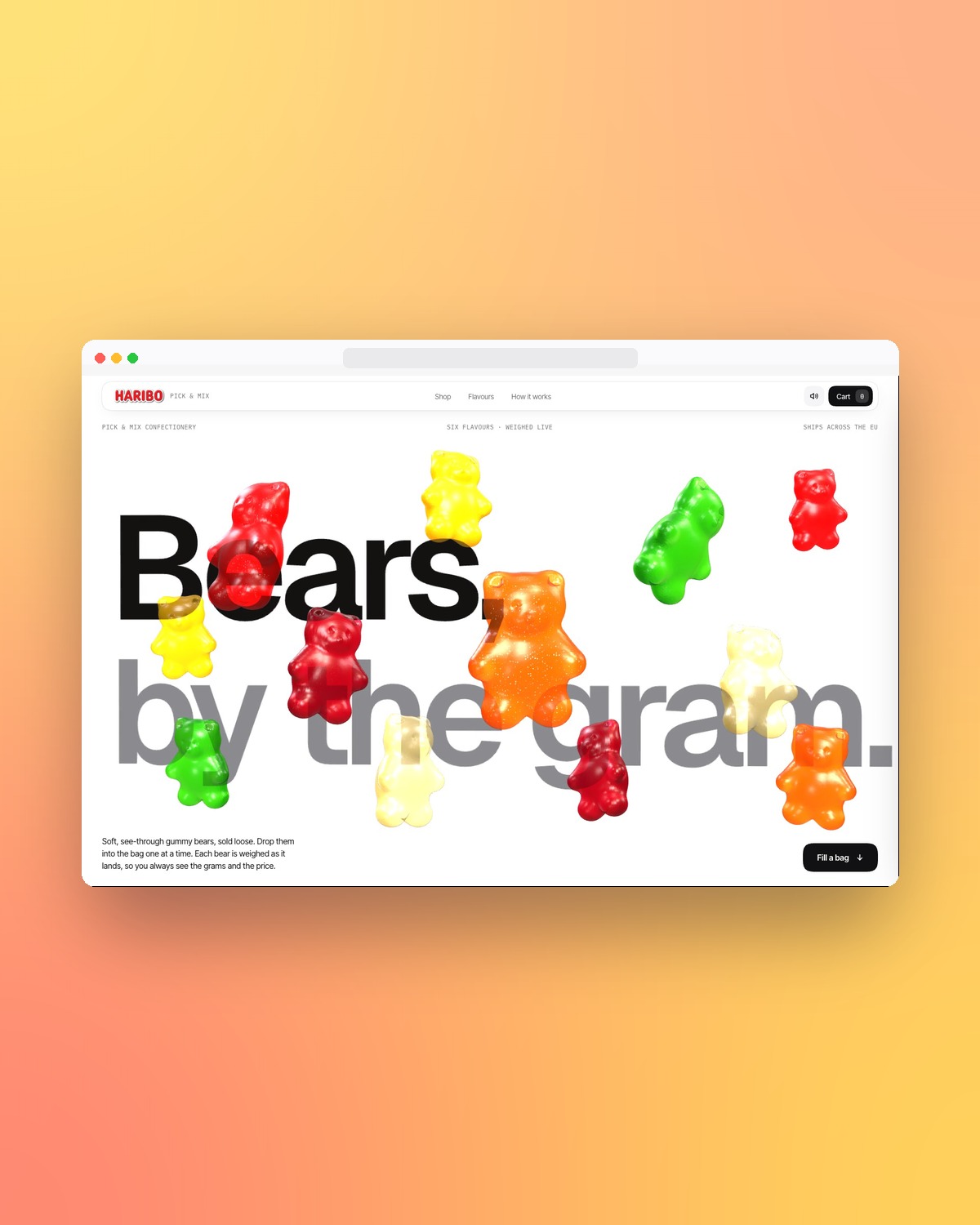
My Verdure experiment is a landing page with a camera: open your hand and a glass flower blooms, be rude to it and it wilts and drops its petals. It was designed in Figma and built with Claude through the Figma MCP, with MediaPipe hand tracking, a WebGL water surface, and Higgsfield and Kling for the video. After a week of Dessa learning timing from speech and agents learning Minecraft from each other, a page that reads a gesture feels like the small, shippable version of the same idea: input that is not a button.
OTO Custom: repaint a Porsche from one photo
OTO Custom is a car configurator that recolours every part live from a single photo, using a WebGL recolour shader, with a Kling-generated turn to show the back. Figma, Claude and the Figma MCP again. It is my answer to the problem SurgePix is attacking: one generated image is a dead end unless you can edit parts of it. Here the parts are body, wheels and trim, and the edit is instant. Both demos are on my AI experiments page, where each item lists the exact tools.
What this week means for designers
The big labs had a loud week: Google announced Genie 4, a world model with audio and live steering, in research preview on October 27, and new frontier models landed from Google, OpenAI and Mistral within days of each other. Almost none of that is usable by you today. The creations above are, and they point in one direction: AI is becoming something you run and shape, not something you visit. Hob and Survival LLM run on the laptop. DOOMFORMER runs in a game engine. SurgePix hands you layers. Dedica grades your site for a visitor that is not human.
The hype check: Dessa has no public weights or benchmarks. Survival LLM gave someone wrong fire-starting advice. The Minecraft agents spent most of three hours fishing and holding meetings. Simon Willison's "fun" is his own judgment after a month of play, not a study. Keep all of that in mind before you tell a client that agents are ready to run their product.
The design lesson I take is about audience. For 12 years I designed for a person looking at a screen. This week two of the nine creations are built for an agent looking at a screen, and a third is a model that only listens. The craft does not go away; it splits. You still need clarity for people, which is what I argued in the five shifts I already ship in UI and UX design with AI, and now you need legibility for machines too. The people best placed to do both are designers who can read and write the code, which is why I wrote about what a design engineer actually does. The trust side of this, shipping AI features that people accept, is the story of the ViewStats creator tools case study.
If you want this kind of thinking inside your product, with someone who designs it and ships the code, work with me as your design engineer. Last week's issue, on agents cleaning up smart TVs, is the October 23 roundup of AI creations.
Frequently asked questions
What were the best AI creations this week?
For October 24 to 30, 2026: Y Combinator Labs' 50-agent Minecraft civilization, DOOMFORMER (a neural network compiled into DOOM maps), Block's Dessa speech-only conversation model, Hob (an open-source local alternative to Claude Cowork), Survival LLM (an offline assistant over a 930,000-article library), SurgePix (layer-editable AI visuals), Dedica (an agent-readiness audit for websites), Ben Winding's Encarta 95 in the browser, and Simon Willison's batch of vibe-coded games.
What AI tools are people using to build apps and games right now?
This week the named tools were Claude Opus 5.5 and GPT-6.1 Sol for agents and games, three.js for browser games, llama.cpp with open-weight Gemma 4, gpt-oss, Qwen and Granite models for local assistants, and Claude Code and Cursor as the agents that SurgePix and Dedica plug into. In my own experiments I mostly use Figma, Claude and the Figma MCP, with WebGL, SwiftUI, Higgsfield and Kling.
Is a local AI app like Hob good enough to replace ChatGPT or Claude?
For private work on your own files, with no account and no data leaving the machine, it is already useful on a 16 GB laptop. For hard reasoning, long documents or reliable tool use, the hosted frontier models are still ahead, and Hob's author says tool calling with small models was his hardest problem. Try it for the private tasks first.
What is new in AI this week for designers?
Two shifts. AI image tools are starting to output editable layers instead of flat pictures (SurgePix), and websites now have a second audience of AI agents whose success you can measure (Dedica). Both reward designers who understand structure, not just visuals.
How often is this AI roundup published?
Once a week, every week, with six to ten creations from the last seven days and one or two of my own experiments.
hello@ayoubka.com
If you have a web or mobile app idea in mind or you need some advice about product design, feel free to get in touch ✉️