
Lovable ElevenLabs Integration: Voice and Music, No SFX Yet
Lovable apps can call 4 ElevenLabs models since Nov 25, no API key. What shipped, the limits, and how a product designer who designs sound would use it.
The Lovable ElevenLabs integration went live on November 25, 2026: apps built in Lovable can now call four ElevenLabs models (Eleven v3, Eleven Multilingual v2, Eleven Flash v2.5 and Eleven Music v2) with no ElevenLabs account or API key. An admin switches ElevenLabs on once, and from then on Lovable uses it for new speech and music features, billed as workspace credits. My verdict as a product designer who designs sound for his own builds: it is a real shortcut for narration and background music, but it is not UI sound design. There is no sound effects model in the list, the voices are a fixed set of 22, and every place the audio plays carries a "Powered by ElevenLabs" label. Below is what shipped, what it changes for designers, where the hype is ahead of reality, and how I would use it.
What the Lovable ElevenLabs integration actually is
Lovable already had a built-in AI connector: you describe a feature in the project chat ("add a read-aloud button to each lesson") and Lovable writes the backend function, handles the key and wires the model. ElevenLabs is now one of the optional providers inside that connector. According to the official Lovable changelog, the four models are:
- Eleven v3: expressive narration, such as dialogue in a story. This becomes the default for new speech features.
- Eleven Multilingual v2: natural narration across languages.
- Eleven Flash v2.5: fast responses, such as reading a short reply aloud.
- Eleven Music v2: music your app can start playing while the track is still being composed.
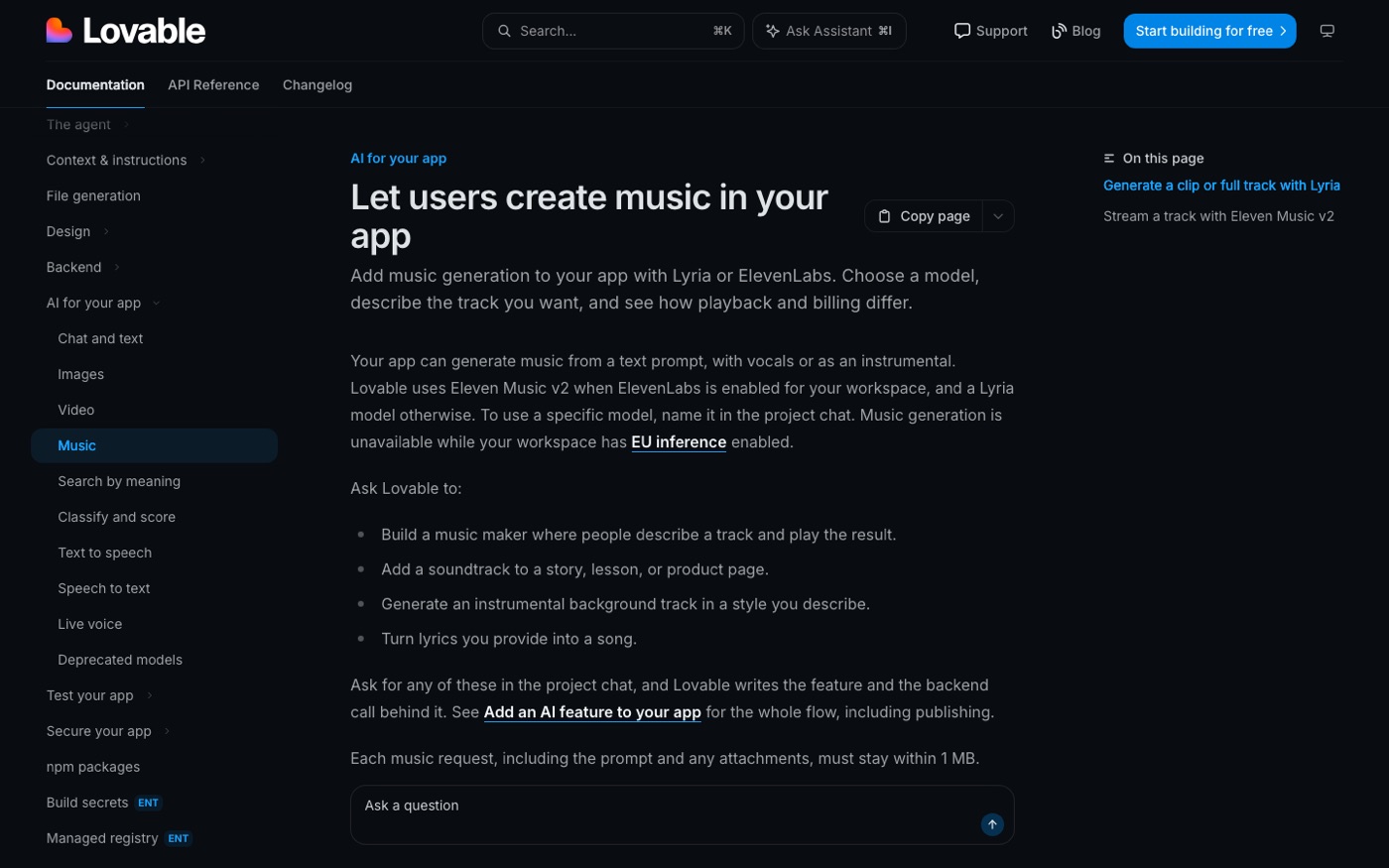
The details in the Lovable AI features docs matter more than the headline. Speech uses one of 22 voices licensed for Lovable (Darian is the default when you do not ask), and your app cannot use any other ElevenLabs voice through this route. For a custom voice you still connect your own ElevenLabs account with your own key. Music tracks can run from 3 seconds to 10 minutes. The docs list the underlying ElevenLabs rates: $0.04 per 1,000 characters for Flash v2.5, $0.08 for v3 and Multilingual v2, and $0.0025 per second of music. And ElevenLabs is not available at all while a workspace has EU inference turned on.
What it changes for product designers
The real change is not the voice quality. ElevenLabs voices were already good. The change is that audio stopped being a separate project. Before this, adding narration to a prototype meant an account, a key, a backend call and a place to store the files. Now it is one sentence in the chat and an admin click. That moves audio from "phase two" into the first prototype, which is where design decisions get made.
That matters because sound changes how people judge an interface. A lesson app that reads the first paragraph aloud feels like a different product from one that does not. A meditation or story app is mostly sound. If the first version a founder sees is silent, the team designs a silent product and adds audio at the end, usually badly. If the first version already talks, the team starts asking the right questions early: when should it talk, how long, can I stop it, what happens on a train with no headphones.
The second change is streaming music. Eleven Music v2 can start playing before the track is finished. For a designer this turns a loading problem into a pacing problem: you are no longer designing a spinner for a 30 second wait, you are designing the first seconds of a track the user hears while the rest is being written. That is a motion and timing question, and it belongs to the designer, not to whoever wires the API.
Hype vs reality
I like this release. I would still not oversell it to a client. Here is the honest version.
| What people will assume | What the docs actually say | What it means for your design |
|---|---|---|
| "Lovable can do any ElevenLabs sound now" | Three speech models and one music model. No sound effects model. | Taps, shatters, rewards and errors still need another path. |
| "I can use any voice" | 22 licensed voices. Custom voices need your own ElevenLabs key. | Brand voice work is still a separate setup. |
| "It is free because there is no API key" | Billed as workspace credits per character or per second of audio. | A read-aloud on every page has a running cost. Cache what repeats. |
| "The audio is fully mine to style" | A "Powered by ElevenLabs" label appears where audio plays, and provider rules ask you to keep it. | Design a place for the label in the player from day one. |
| "It works everywhere" | Not available with EU inference enabled. | European teams with strict data settings cannot use it yet. |
| "Users can build a music library" | People can save and replay their own tracks, but the app must not offer them to others as a catalog. | No shared playlists or public track feeds built on this. |
The missing sound effects model is the gap I care about most. When people say "sound in apps" they usually mean narration. When I say it, I mean the small sounds that make an interaction feel physical. Those are a different craft, and this integration does not touch them.
Where it fits in my workflow
I take my AI design experiments from idea to design to code, and sound is one of the layers I design myself, next to motion and interaction. Across those builds the sound comes from three places, which I compared in my post on UI sound design for product designers:
- Generated one-off effects. The LevelUp celebration screen lists ElevenLabs sound effects among its tools: the badge, the confetti and the sound are one moment.
- Synthesized in code. The stdo. keyboard landing page is built on Web Audio synthesis, and the Haribo Pick & Mix bag generates every crinkle and plop at runtime with ten random variants. I broke that down in how to make a 3D configurator.
- Placed in space. In Payno, the card you tap to shatter, the cracks come in left, center and right variants through a stereo panner. That build is in micro interactions examples.
None of those would come out of this integration, and that is fine. It covers a different job. Here is where I would reach for it:
Narration as a design material. For onboarding, lessons or a story screen, I would let Lovable wire Eleven v3 into the first prototype, then spend my time on the parts a model cannot decide: when the voice starts, whether it waits for the animation, how the user pauses it, and what the screen shows while it speaks. That is the same rule I use for UI sound: match the audio to the motion, or the screen feels laggy.
Background music for a single moment. A short instrumental bed under a reveal or a result screen, generated once, saved to storage and reused. Not a new track per visit, because that is both a cost and a consistency problem.
Fast voice replies. Flash v2.5 for reading a short answer aloud in an assistant-style screen. Here the design work is the interruption model: one tap to stop, and never talking over the user.
For anything tactile, I would keep doing what my builds already do: generate a few effects, or synthesize them in code with the Web Audio API, and design them with the animation as one piece. If you are choosing between Lovable and other builders for this kind of work, my comparison of v0 vs Lovable vs Bolt covers the wider trade-offs.
Design rules before you ship voice or music in a Lovable app
These come from how my own builds handle audio, and they apply even more when adding sound is this easy:
- Never autoplay. Browsers block audio until the user interacts anyway. Make the first sound one the user caused.
- Always give a stop. A visible pause or mute, remembered between visits.
- Design the label in. The "Powered by ElevenLabs" label will be there. Place it in your player design instead of discovering it in QA.
- Cache what repeats. The same welcome line should be generated once and stored, not paid for on every visit.
- Write for the ear. Text written for a screen often sounds stiff read aloud. Shorter sentences, fewer brackets, no tables.
- Test without headphones. On a phone speaker in a noisy room, which is where most people will hear it.
This is the same idea I wrote about in my AI design workflow from idea to App Store: AI removes the setup work, so the designer's time goes into the decisions that make it feel right.
FAQ about the Lovable ElevenLabs integration
How do I connect ElevenLabs to Lovable?
A workspace admin or owner enables ElevenLabs once, either in Connectors under AI Gateway or from the card Lovable shows in the project chat when you ask for a speech or music feature. After that, new speech and music features use ElevenLabs unless you name another model. Apps you already built keep their models.
Do I need an ElevenLabs API key for Lovable?
Not for the four built-in models. Lovable bills them to your workspace credits. You only need your own key for custom voices from your ElevenLabs account or for ElevenLabs speech to text, through the separate ElevenLabs connector, and then ElevenLabs bills you directly.
Can Lovable generate sound effects with ElevenLabs?
Not through this release. The four models are three speech models and one music model. For UI sound effects you still need to generate files elsewhere or synthesize sounds in code.
Is the Lovable ElevenLabs integration available in Europe?
It is not available while a workspace has EU inference enabled. Workspaces without that setting can enable it on all plans.
Is Eleven Music v2 in Lovable good enough for a real product?
For short beds under a moment, yes, as long as you save and reuse the result. Keep artist names, song titles and lyrics out of prompts, and do not build a shared catalog of generated tracks, since the provider rules forbid it.
Try it on one screen this week
Pick one screen where sound would change how it feels: an onboarding step, a lesson, a result. Add a read-aloud or a short music bed, then spend more time on the timing, the stop button and the label than on the prompt. If you want a product designer who designs the motion, interaction and sound and ships the code, have a look at my product design work and work with me as your product designer.

hello@ayoubka.com
If you have a web or mobile app idea in mind or you need some advice about product design, feel free to get in touch ✉️